The Hunt - Where Preparation Meets Reality
- Nov 12, 2025
- 10 min read
Back to Camp
When my season finally arrived my dad and I linked up around two in the afternoon at the same area we camped five years ago. He had a longer drive than me but he still beat me there—traffic added almost two hours to my drive—and had already scouted for other hunters while he waited. We were a little surprised that some of the “better” camp sites were still empty when we arrived a full day before the season opened.
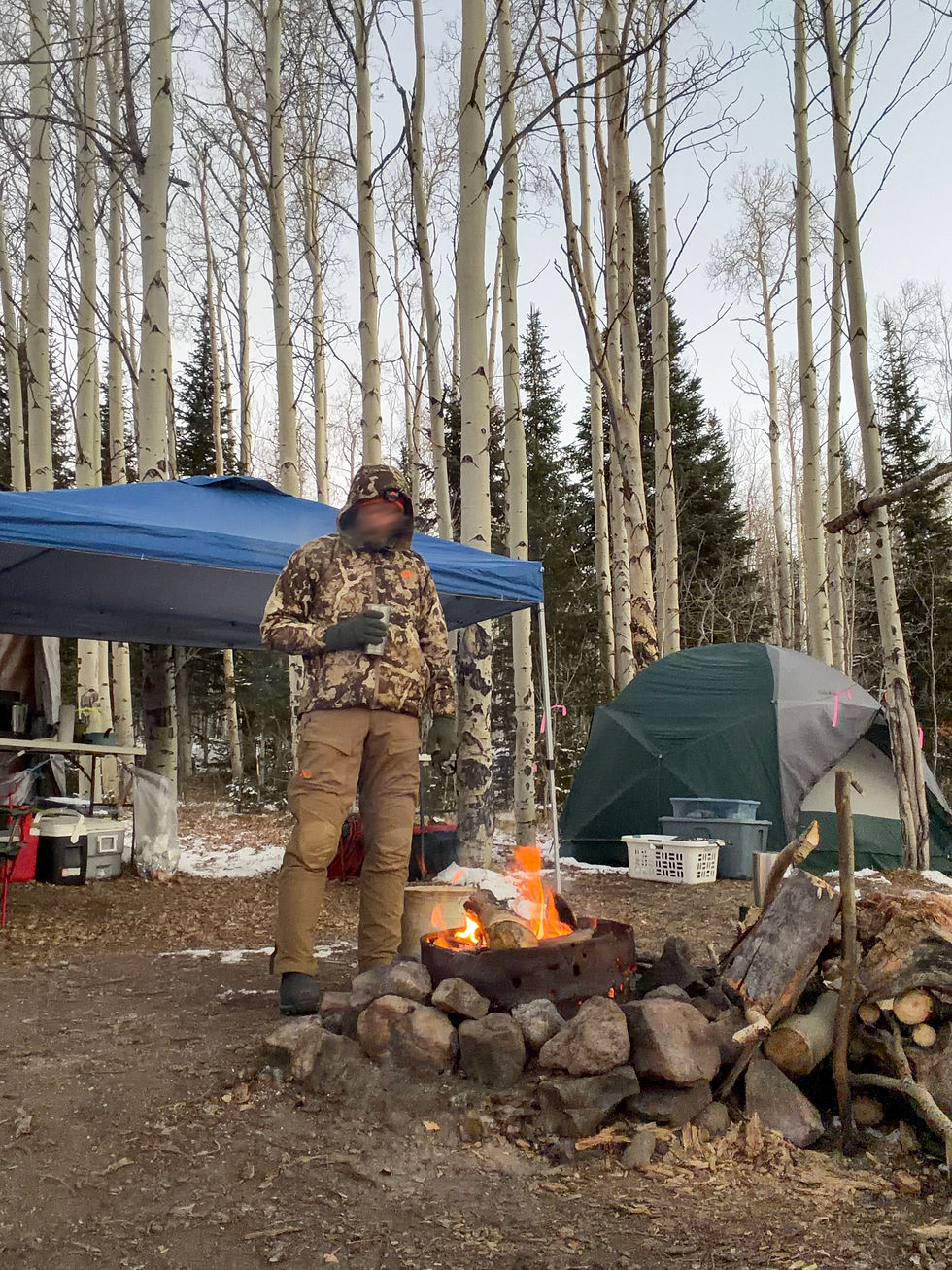
Rather than stay at the site we made camp 5 years ago. We picked a different campsite next to a shallow pond that gave us plenty of sunlight during the day and remarkably a few bars of cellular signal. The weather was perfect for camping, and terrible for elk hunting: clear skies, warm air, with little to no wind the first day. We set up a simple base: a tent, an awning to cook under, and tarps strung through the trees to block wind and hide camp from the road. The tarps worked better than expected, muffling noise and giving the spot a tucked-in feeling. Overall, not a bad camp set up. Everyone else around us was in walled tents, campers, fifth wheel trailers with UTV’s and ATVs being towed by heavy duty pickups. We were low on budget but high on grit.
That first night I barely slept. The combination of excitement, anticipation, and memory kept me restless. I slept in two hour increments and was up at 4 a.m., making coffee and breakfast before Dad even stirred. It wasn’t cold—too warm, really—but I knew a front was coming. The forecast said snow, and that meant one thing: I needed to hit the high, rough trails first while they were still passable.
This year every choice was about timing and doing the hard things early so weather wouldn’t take them off the table later. Based on my scouting I knew that once the snow came many of the roads that I wanted to travel on would be tough to drive on so I needed to prioritize them.
Into the Woods Hunting
I settled into a daily rhythm of a 4 a.m. alarm, coffee, breakfast, gear up, drive to an access point, hike in under headlamp light. I wanted to be miles into the forest before the world woke up. By sunrise I’d usually covered two or three miles, depending on the amount of deadfall that I had to cross and whether or not my access point started at a designated trail head or not.
The first morning was a gut punch but I shouldn’t have been surprised. When I woke up it was obvious that I was the first one up in the forest. None of the other camps around us were making noise and the lights were all out. When I got into the 4Runner it was confirmed that I had beat everyone out of bed as I passed dark campsites on my way to an access point. The drive up the old mountain road was uneventful, but as I neared the top, I saw more camps set up on the side of the road. At the very top a large campsite was present, and I had to park at the farthest point to avoid disturbing them. They were up and moving and starting to get ready for their day no doubt a little surprised someone was already moving into the woods. I put on my gear and started hiking old sign was everywhere when the sun came up, but no elk, and plenty of hunters. The realization came fast and familiar: This feels like five years ago. I pushed that thought down, reminded myself that the plan accounted for this, and forced myself to trust the process.
By the second day I started finding fresher sign and piecing together small ambush opportunities, but I still hadn’t seen an elk which worried me. The hunting pressure was heavy on the periphery, and I could see that hunters were trying to position themselves between the public and private land in hopes of intercepting elk moving back and forth. I could feel it in my legs and my head—hunters driving roads, glassing from trucks, leaning on luck. I was hiking farther than most and still coming up empty and each empty day added a layer of doubt.
By mid-week, Dad and I noticed the pattern. While I was deep in the forest, he was keeping an eye on camp and watching what the other hunters were doing. He occasionally drove around to check out the unit but noticed that eventually every day another group packed up and left. One truck we met had three hunters in it and the driver told us they had three cow tags to fill. I almost laughed out loud when he said it. I had just hiked from one drainage over a saddle to another drainage and didn’t see a single elk. Tired, sore, and frustrated I held in my comments and laughter. When I finally filled my tag, we were one of two camps left in the entire area. There were no easy buttons left to hit this year. The mountain and the unit had tested everyone’s patience.
The Day Everything Changed
That morning started chaotic. I was tired and frankly was looking for an excuse for a break. My heels had blisters the size of fifty cent pieces that I had been trying nurse all week. They were stacked with band aids and moleskin to try and slow the blisters. The days of warm weather created hotspots in my boots that only got worse. I told dad I decided to check a different part of the unit, so Dad and I drove over together in his vehicle. It was busier with hunters everywhere and everyone we talked to said the same thing: no elk. Some blamed the weather, many blamed the wolves, but all said there were no elk in the unit.

As we headed back to camp and merged onto the highway, we heard the unmistakable thump of a flat tire. We pulled over frustrated about the situation. We pulled tools out, and started working, but the spare was rusted to its mount and refused to budge. After a long, frustrating wrestle, Dad figured out how to break it free. We replaced the tire and drove to the nearest town for a proper fix and a hot lunch. We lost almost an entire day to our little excursion.
By the time we rolled back into camp, it was close to 3 p.m. I wanted to hunt that evening but was tired, frustrated, and ready to call it a day. While talking with my brother on the phone, I decided to make one more attempt at an evening hike into a spot that had shown the best sign earlier in the week. My logic was simple because of the fresh snow: If I don’t see sign, I’ll hunt somewhere else in the morning.
When I got to the trailhead snow still clung to the ground. Unsurprisingly it was untouched by other hunters. I set off down the trail, fast and irritated, half hiking and half venting my frustration through movement. My rifle was clipped to my pack, poles in hand, covering ground quickly on the easy trail. About 500 yards from my planned overlook, I came around a low area that probably holds seasonal water and I froze.

A group of elk, maybe seven to ten cows and spikes, stood in the clearing. It was obvious that I scared them onto their feet, and they nearly scared me off mine. In my angry hiking with my head down I was caught totally off guard. Luckily trees blocked their full view of me, but it didn’t matter because I couldn’t get my rifle free. One of the clips that had securely held my rifle to my pack had wedged itself between my scope and stock. My hands fumbled with the buckle; my poles clattered quietly against my legs. I pulled out my rangefinder and ranged a cow at 79 yards. When I was finally able to free the rifle and bring it up she walked away like she knew exactly how long it took me to unclip.
Thinking I knew where they would be headed I looped up the trail, hoping to intercept them. I waited fifteen minutes, with heart still hammering, then decided to back out and not blow the spot for a potential morning sit. At this point I had just taken a ride on the emotional roller coaster. I felt frustration, excitement, disappointment, pride, and finally resignation. As I turned back to head to my vehicle, I made one subtle change: I stowed my hiking poles and carried my rifle in my hands.
That decision changed everything.
The Shot
About a half a mile from the trailhead movement flickered ahead. The same group of elk I’d bumped thirty minutes earlier stood on the open trail. They’d gone left instead of right, circling back toward the valley. The herd split and half rocketed downslope through thick timber, the rest angled uphill. I quickly raised my rifle as one elk bolted directly in front of me. Her haunch filling my scope but not providing a shot. It all happened fast but it felt like an eternity. I side-stepped along the trail, keeping pace with the animals still in sight, looking for a window through the trees. Nothing. For a moment I thought, there goes my last chance.
Then a cow stepped broadside between the trunks and branches. I knew this was my last chance. I quickly grunted in an attempt to stop her. The noise from my mouth sounded loud and alien against the quietness of the forest. She stopped and instinct took over. Brush and tree limbs were in my shooting lane, so I leaned forward to check for antlers. None. Next, I quickly found the front leg, moved my crosshairs up and back for the shot.
I fired free-hand at 59 yards (I ranged the tree after the shot), the 180 grain Barnes TTSX solid copper bullet punched through a thin wall of branches. I’d thought about this scenario all week and wondered how and if brush could deflect a bullet at short range. I decided to trust the “physics” of short range and solid copper.
She vanished into the trees.
The Recovery
After the shot my arms buzzed and tingled as the realization hit me that I had finally connected the dots of a DIY elk hunt. The only thing left was to find the elk, butcher it, pack it out, and get it home.
I hiked to where she’d stood before my shot. Bright blood sprayed across the snow. I was back on the emotional rollercoaster. Relief. Confidence. Worry. I called Dad, who was back at camp starting dinner, and told him to bring lights and gear. I marked the spot of the shot and where the elk was on OnX, then hiked out to drop extra weight from my pack and meet dad at the vehicle before heading back in with him.

Darkness had fully settled in by the time we reached the spot I took my shot together. As we began following the blood trail we had high hopes. Then it happened, a heavy crash echoed through the trees. I knew immediately what it was, it was the sound of a wounded elk bolting through the forest high on adrenaline. My stomach flipped. A few moments later we found the bed where she’d laid down, blood pooling.
Rookie mistake. Rather than push her deeper into the forest, we backed out and hiked to the vehicle and returned to camp. The temperature dropped into single digits that night—cold enough to preserve the meat.
The Next Day
At first light we returned, confident we’d find her quickly. Instead, we followed the wrong track for hours because we lost the blood trail. Frustration set in until we decided to hike to main trail and I looped back to the previous evening’s site and started combing every inch of melting snow. Eventually, I found the true blood trail. For the next few hours I methodically combed the forest floor following specs of blood and hoof prints in the snow. As the day wore on and the snow began to melt and therefore removing all traces of tracks I’d pause and walk in a half circle looking for any sign of blood or track I could find. Often times I’d find blood on a stick or rock or I’d cut the track and blood in partially melted snow beyond the gap. Ultimately the snow thinned, but it led to her.
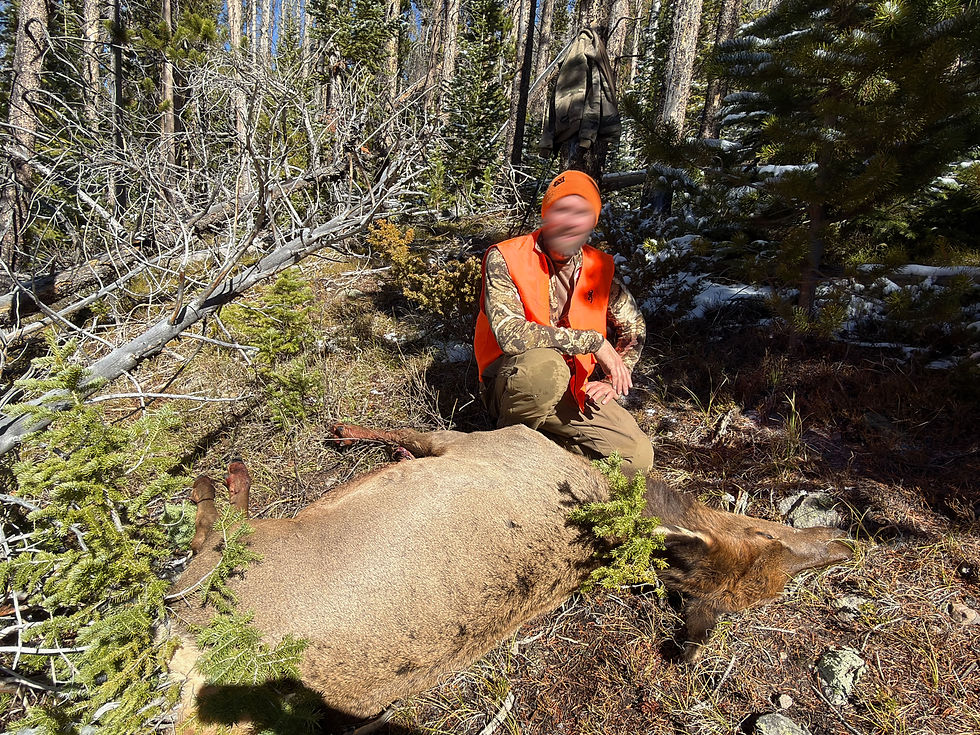
When I finally saw the tan hide among the downed trees, that buzzing feeling returned except this time to my face. I sent a text to my family: I found her. I hiked back down to meet up with my dad so we could walk in together and get to work on processing the meat.
Processing her wasn’t hard, it was just deliberate. I’d cleaned plenty of deer, but this was my first elk and our first time doing the gutless method. It worked well, and she’d fallen perfectly for the job. The challenge was the clock; the sun was warming the air, and we felt the pressure to finish before spoilage became a concern. We quartered her, bagged the meat, and started the pack-out. Dad carried a front quarter; I hauled a rear and a front quarter on the first trip out. We left the meat bits and a front quarter in a shaded spot on top of snow. When we got to the truck dad made the first run back to camp while I turned around for the second load. By the time everything hung from our meat pole, the day was gone and we were exhausted. Sore. Proud.
The Drive Out
The full weight of what we did really didn’t hit me until the next morning, leaving camp. I led the convoy out with Dad’s truck in my mirrors. We were exhausted, sore, sick, and hurting but we were leaving the woods in victory. The road twisted through the timber and eventually opened to the highway. He’d turn left toward his home, and I’d turn right toward mine and in a strange way I was sad it was over. It felt as though a chapter closed and I wasn’t ready for it.
As the miles passed and somewhere between those mountain passes and the exhaustion, I laughed but mostly I cried. There will never be another animal that I harvest that carries as much meaning to me as that elk and this will be a story of adventure that I carry with me forever.
Some hunts are measured in meat. Others in meaning. This one was both.
T³ Debrief
Where preparation meets perspective — what worked, what didn’t, and what I learned.
Tools
Rifle Carry System: The comfort was worth it—until speed mattered. Next time: refine for faster access.
Garmin InReach: Essential for coordinating with Dad during the recovery.
Gear Efficiency: Carrying fewer luxuries made the pack-outs survivable.
Snow: Not gear, but a tool I used. Tracking in snow made recovery possible after my mistake.
Tactics
Prioritizing high routes early before storms hit was the right call.
Trusting e-scouting and flexibility kept me in the game while others quit.
Backing out and waiting overnight on the wounded elk preserved the outcome.
Mobility and persistence—keep moving until you find sign—proved decisive.
Timing
The decision to carry the rifle in hand changed everything.
The flat tire delay ironically aligned my timing for the only successful encounter.
Shooting light was nearly gone when I fired; patience met opportunity in the final hour.
Leaving her overnight was the correct call—a hard lesson in restraint.

Comments