Miles Hiked, Lessons Learned: Scouting and the Preparation
- Nov 11, 2025
- 8 min read
Back to the Beginning
The weekend wasn’t going to be great, but I wanted to put the odds in my favor as much as possible so to the mountains I went. It was going to be wet, but it was the only time I could go scouting before the elk season opened. As I got closer to the mountains rain tapped steadily against the windshield. It had been five long years since I last hunted this unit. The last time, I had returned home with an empty cooler and a heavy heart.
This season wasn’t merely about chasing elk; I was seeking connection. My family’s roots run deep in the area I was hunting. As a child, we would drive to these mountains to camp and fish and enjoy the outdoors. I had an aunt and uncle who lived nearby; my uncle had guided loggers through these very forests. Although I had never met him, the stories painted him as a man of the woods—tough, quiet, and capable. So, returning to hunt here with my dad felt like stepping into those stories.
Driving back to the area stirred a mix of emotions. I felt excitement for the chance to redeem myself and anxiety about the very real possibility of leaving empty-handed again. I was optimistic about the possibility of this year being different because I was acclimated to the elevation but carried the fear of another year passing without harvesting an elk and dealt with the question of how many more opportunities will I have to do this with my dad. I wanted to return home as a victor, not for ego’s sake, but to honor the work, the tradition, and the family connection.
During my drive I would catch myself wondering why I had come back here. The memories of failure, the dense timber, and the endless silence of the forest would flood my mind. Those same feelings reminded me of some of the reasons I hunt—you can’t grow from comfort.
The Study Phase
Preparation for my elk hunt began months in advance. In the evenings I would open OnX Maps and embark on my digital reconnaissance. Since I had been onsite years before I had a general idea of the layout of the unit, but I wanted to explore the units around it since I had access to them as well. I chose one other unit to explore and started plotting access points and routes.
Hours during the week were dedicated to tracing ridgelines, drainage systems, bedding zones, and potential pressure points. I immersed myself in the hybrid and LiDAR topo layers, constructing a mental map of the terrain that was miles away. I dropped pins, color-coded possible routes, and meticulously drafted backup plans for my backup plans. The lesson I learned 5 years ago was don’t be tied to where the elk aren’t, stay mobile and find the elk.

I dove into every resource available: Meateater, Fresh Tracks, Outdoor Class, and Elk University, YouTube, and more. Each provided valuable insights, but I soon realized that the elk hunting techniques they showcased—wide-open basins, long-range glassing, and 200+ yard shots—didn’t align with my reality. My country is compact, with dense aspens, tangled spruce, and visibility limited to a handful of yards, not miles. Shots come swiftly and close and you’re almost better off with an open site .30-30 than a scoped 300 Winchester Magnum.
So, I boiled down the broad lessons I learned and adapted them to the terrain I was familiar with. Behavior patterns, thermals, and feeding times remained relevant, but the tactics had to be tailored to the dense forest. I wasn’t going to be looking for bodies lying on benches or mountain sides 400 yards across a drainage. I was looking for bedding areas, feed, water, seclusion, and signs of animals under my feet. I was looking at wind direction, angles of approach and areas that were the most likely to have elk in it or passing through. I was going to be looking for flashes of movement from a tail or an ear or the curve of a leg.
“The enthusiasm to start is common. The grit to stick with it is rare” - Author Unknown
Eventually I had e-scouted so much that I noticed a creeping sense of decision fatigue. The maps began to blur together, and I reached a point where additional planning would only create confusion. So, I closed the laptop, put down the notepad, and shifted my focus to validating my e-scouting findings with boots on the ground. My preparation had to transition from theoretical to practical.
Boots on the Ground Scouting
A few weeks before opening day, I took off on a solo scouting weekend. The journey was an adventure in itself, involving interstate highways, then highways, then gravel roads, and finally, dirt tracks that barely qualified as roads.

The region had been experiencing heavy moisture over the previous weeks, and the area was forecasted to get more rain and that’s exactly what happened. The already waterlogged roads were terrible. The mud here is a fine, silty paste that compacts into tire treads, rendering them effectively like racing slicks. Traction vanished, and on more than one occasion I had to back down narrow trails or turn around on tight mountain trails. Each time with my heart pounding as I reminded myself of the distance from anyone who could assist me if things went wrong.
The weather conditions not only made driving challenging, but it made scouting a challenge as well. The poor visibility, the woods drenched and silent, and the roads leading to my preferred spots were impassible with my 4runner. If the mud didn’t stop me the slick rocks and boulders on trails became the next barrier to my effort. Despite these obstacles, I still gathered valuable information: I identified impassable routes based on weather, discovered potential drainage areas that might still hold elk, and made decisions to abandon plans in the neighboring unit.

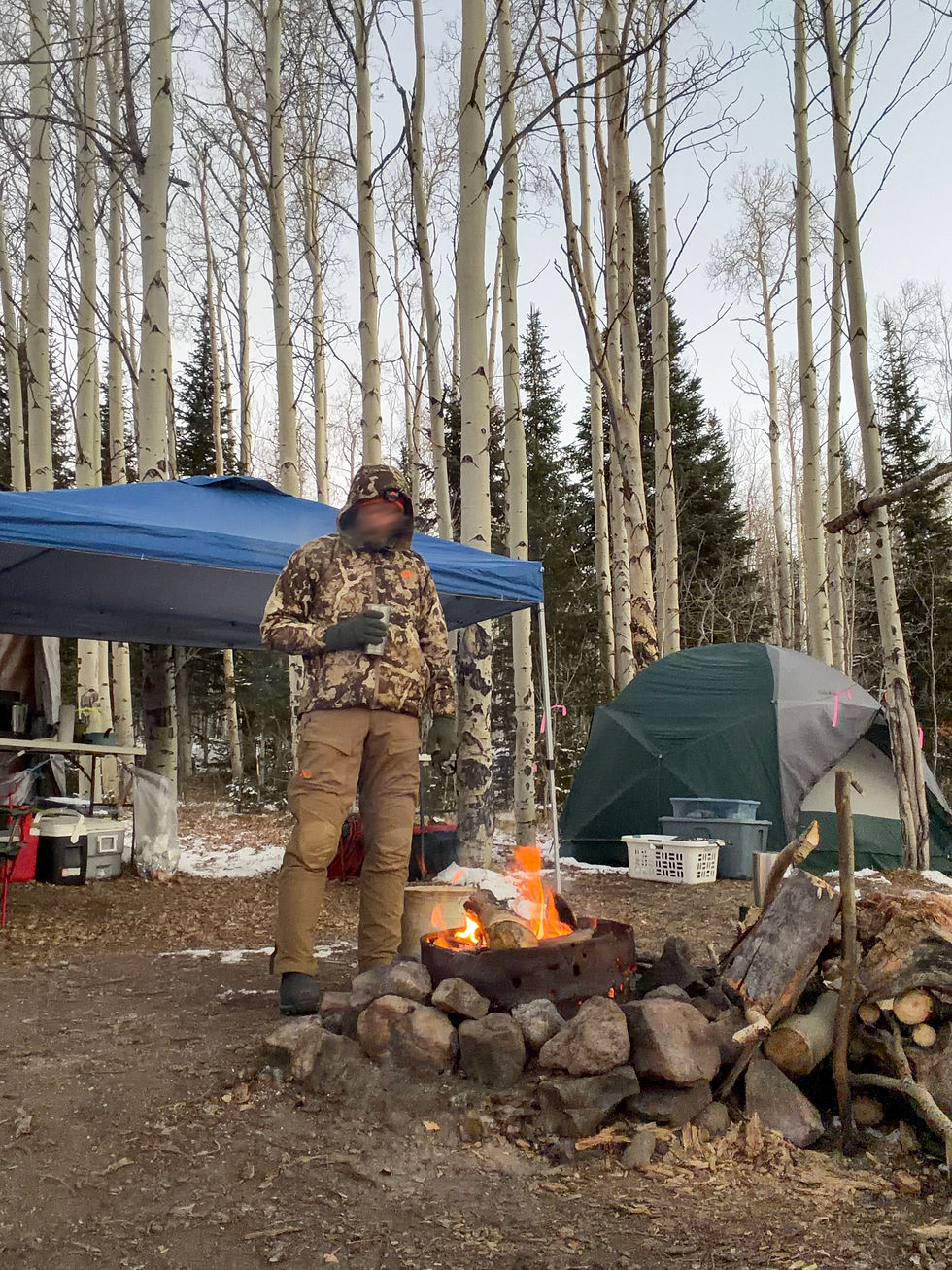
So I could stay mobile and maximize my time scouting I opted to sleep in my vehicle rather than deal with a tent. I organized my vehicle to I could push my gear to one side of the vehicle, roll out a sleeping bag, and attempt to sleep. It was an unusual sensation, lying alone in a dark forest surrounded by glass. In the pitch black every sound was amplified from the drip of rain to the rustling of the trees in the high winds.
People often underestimate the psychological impact of the night in the backcountry. I’ve found that you must really control your thoughts and not let you imagination run wild otherwise you risk only leaving the comfort of your car or tent when the sun comes up. That’s a problem when you choose to do hard things like elk hunting because it requires you to be in the woods hours before sunrise and if you’re running and gunning solo like I do it can be hard to take that first step. Bottom line is that hiking out before dawn through pitch-black timber requires a specific mindset.
During my scouting I didn’t see a lot of evidence that elk were around. There were some scattered droppings and a few faint tracks softened by the rain, but nothing fresh enough to confirm the presence of elk still in the area. It was difficult not to succumb to the same doubts I had carried for five years. Was I wasting my time? Why did I think coming back to this unit was a good idea? Eventually, I reminded myself of my reasons for doing this. I enjoy challenging myself. Elk hunting is demanding, and demanding things are often the ones worth pursuing. Gratitude also played a role. I reminded myself of how fortunate I was—camping in a wild place, carrying a hunting tag, and the opportunity to share the hunt with my dad was something I had dreamt about years before my first DIY elk hunt.
Refining My Gear
The scouting also helped validate my plans for my gear. By this point, most of my gear had been refined from past hunts. There are lots of clothing lines for hunters to choose from. I’ve been using First Lite clothing for years at this point because I think it strikes a balance between cost, quality, and versatility. I like the layering system, and it works well for me and my style of hunting. This year, I added a windproof/waterproof jacket and pants after seeing forecasts predicting snow and single-digit temperatures. I choose neutral colors (not camo) that are suitable for both hunting and everyday winter wear; budget constraints necessitate versatility.
If you follow this blog and future posts, you’ll find that most of my gear aligns with my general backcountry loadout. If it doesn’t serve a purpose in multiple contexts, it usually doesn’t stay. I don’t have the funds or the space to have gear that are one trick ponies.
However, a few modifications were made based on the scouting trip:
I discovered that my match carrier wasn’t rough enough to strike matches, so I added a small box striker to my kit.
I replaced my rifle carry system. The old setup put too much weight on my shoulders, while the new one anchored the rifle to my hip belt for better balance. It wasn’t perfect—it reduced accessibility—but the comfort trade-off was worth it, mostly.
Fully loaded, my pack tipped close to forty pounds. Way to heavy but I managed. I plan to start cutting ounces where I can in the future as funds allow.
Mental Preparation and Systems Thinking
I find managing the mental load is the hardest part of hunting, even more challenging than navigating the terrain. Decision fatigue can break you faster than any obstacle, so I spent a lot of time before going out working to minimize making decisions and free up mental space for use in the field. I suffer from a version of FOMO (Fear Of Missing Out) when I’m in the field. My dad said it best when he said hunters are hopelessly optimistic. I think he’s right in that we (hunters) always think the target animal is just over the next hill, or we tell ourselves that we will find the animal, and the list goes on. Personally, I always think that whatever animal I’m hunting is “probably just over that ridge” so sitting in one spot is a massive undertaking for me. I’m always second guessing my choices and actions when in the field!
This year, I structured everything to minimize unnecessary choices:

Food: I packed premade breakfast burritos, pre-bagged snacks, and heat-and-eat dinners.
Organization: I labeled dry bags for layers, gear, and my sleep system.
Communications: I had a redundant contact plan with my dad at base camp, including a Garmin InReach, satellite text, and check-in windows.
Hunt Areas: I had multiple locations and elevations planned out to fall back on to minimize decision making on the fly in the field.
My mindset wasn’t “I hope I get lucky,” but “I’ll make my own luck through persistence and preparation.”
Transition to the Season
By the final week before the opener, I felt about as prepared as I could be, but some doubt still lurked. Preparation builds confidence, not control. Sure, I had chosen the routes, marked the maps, and packed the truck but experience teaches that the mountain has its own plans and the real work would begin opening day.
I think that’s the paradox that keeps me coming back. You can do everything right when preparing for a hunt like this. You can study the maps, tune your gear, zero your rifle, condition your body, and then you hand the outcome to the elements, the animals, and the moment. You can only control what you can control when hunting and the rest is left to perseverance and luck.
Coming Up Next: Part II - The Hunt
T³ Debrief
Where preparation meets perspective — what worked, what didn’t, and what I learned.
Tools
OnX Maps: invaluable for pre-season analysis, but limited in thick timber—boots-on-ground still matters.
First Lite Layering System: adaptable for unpredictable mountain weather.
Vehicle Setup: sleeping in-car proved practical for solo scouting when weather turned bad.
Tactics
Created backup-on-backup plans, which reduced decision fatigue once in the field.
E-scouting gave structure, but adapting to reality in rain and mud was key.
Prioritized gear organization and premade meals to preserve mental bandwidth.
Timing
Stopped planning when fatigue set in—switching to packing mode prevented burnout.
Used early access before snow to scout high-country routes while they were still open.
Accepted that not every minute needs optimization; sometimes rest is part of readiness.
Comments